Wednesday, September 19, 2012

NEW! AUGMENTED SCALE Practice Patterns


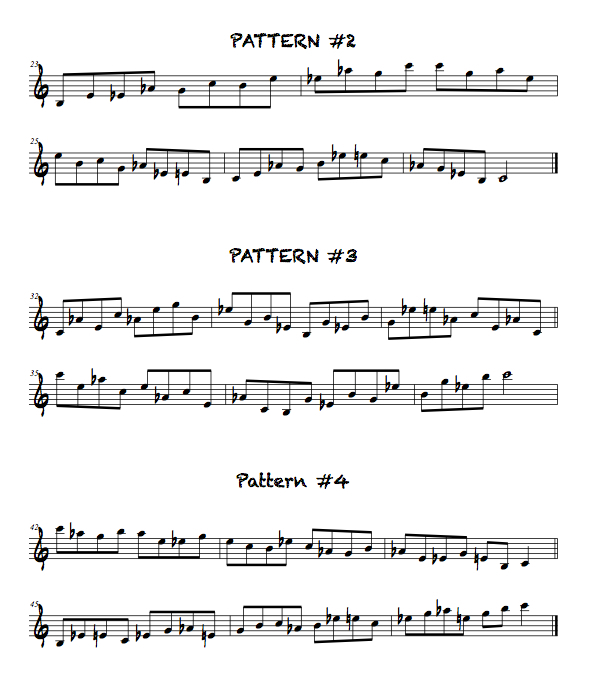
Here are a few new, additional practice patterns, to augment my blog on the 'Study and Etude of the Beautiful Augmented Scale'.
Enjoy and PLEASE leave me comments and subjects you would like to hear about and study.
Thanks so much,
Errol Weiss Schlabach


I will make frequent additions as I compose them.
Sincerely,
Errol Weiss Schlabach


Sunday, September 16, 2012

NEW: Pentatonic Patterns!!!!


Pentatonic Practice Patterns

Here is a beginning of the patterns I’ve promised.  More will follow soon.  Enjoy and please comment and give your opinion.

Sincerely,
Errol Weiss Schlabach


PATTERN PRACTICE METHOD


Seeking, collecting, and cellaring classic vintage patterns will give you material for a never ending rich supply of fresh, interesting ideas to practice.

Select new vintages whenever your present routine becomes dull, monotonous, dreary, tedious and stale.  Visit your tasting room and choose the vintages and bouquets that apply to your current fancy and relish.  Forming the new pattern routine, commit it to memory and build the ability to perform it in every key, major and minor (if this applies).

The goal is to internalize by daily practice until it enters your deep recessive pool, the rich reservoir of your unconscious store of ability.  This stage is achieved when the pattern becomes dull, monotonous, dreary, tedious and stale.  Now go to the tasting room for a new vintage.

It might be days, weeks, or years, but suddenly that retired pattern will surface as you read, hear, or improvise music, vividly screaming in your ‘aural imagination’.  Always remember: your ability to play well requires: “an intensity of concentration and a vivid aural imagination” (Andre Watts).

Please leave comments and opinions for me about this blog.  I hope it helps in your passionate quest of music.
Sincerely,
Errol Weiss Schlabach


A Pattern Practice Method That Works


PATTERN PRACTICE METHOD

Seeking, collecting, and cellaring classic vintage patterns will give you material for a never ending rich supply of fresh, interesting ideas to practice.

Select new vintages whenever your present routine becomes dull, monotonous, dreary, tedious and stale.  Visit your tasting room and choose the vintages and bouquets that appeal to your current fancy, fetish, relish, or
----lust?.   Having formed the new pattern routine, commit it to memory and build the ability to perform it in every key, major and minor (if this applies).

The goal is to internalize it by daily practice until it enters your deep recessive mental pool, the rich reservoir of your unconscious store of ability.  This stage is achieved when the pattern becomes dull, monotonous, dreary, tedious and stale.  Now go to the tasting room for a new vintage.

It might be days, weeks, or years, but suddenly that retired pattern will surface as you read, hear, or improvise music, vividly screaming in your ‘aural imagination’.  Always remember: your ability to play music  well requires: “an intensity of concentration and a vivid aural imagination” (Andre Watts).

Please leave comments and opinions for me about this blog: IT IS very important for me, in order to continue this blog,  to HEAR YOUR COMMENTS!!!.  I hope it helps in your passionate quest of music.
Sincerely,
Errol Weiss Schlabach

Monday, September 10, 2012

Pentatonic Study and Practice Etudes


THE INUNDATING PENTATONIC
THE penultimate scale choice


Scientific evidence has proven that in every known culture throughout the world, all children at a very early age, mock one another with a “naw naw  naw naw naw naw”, which translates musically into intervals of a minor 3rd, a perfect 4th, a major 2nd, and a minor 3rd.  This is 3/5’s of the pentatonic scale.
Another even more common truth: all words for ‘mother’ in every known language start with ‘ma—‘ and drop a minor 3rd to the 2nd syllable.  no wonder any melody containing the pentatonic immediately acquires comfort, familiarity, and respect.

The usual definition refers to the black keys of the piano, or the 1st, 2nd, 3rd, 5th, & 6th steps of the scale.  it’s a lot more than that!:  Most of the academy award songs are based, sometimes almost solely on the Pentatonic (i.e. Henry Mancini’s “THE Days of wine and roses”).  Jazz players, such as Wooy Shaw, have baseD their playing vocabulary on this scale.

great strength and beauty lies in its ability to be used over so many keys and chords: (i.e. The C pentationic can be played over a c69 chord, C7, f69, B-flat, and more for upper structure relationships.  a Pentatonic built off the Dominant tone of a scale (the 5th), can be played over the chord changes of that key ‘til the cows come home, with all notes always sounding good. 

Pentatonics are used over quartel tone harmony in modal playing.   a ‘c’ (or any other) Pentonic can be played over almost any quartel chord because of its   ambiguity: the same quartel chord can keep repeating under a continuing chromatic flow of Pentatonics; or one pentatonic can be played over a chromatic flow of quartel chords (Used when a player is said to play/go ‘outside’ the key of the changes/chords):  We might say it’s extremely democratic----liberal!?

I’ve written these scales in c major; but of course know that you must transpose the material to all 12 keys as you practice.


Please leave comments and feedback!

Sincerely,
Errol Weiss schlabach

Saturday, September 1, 2012

Savor the beautiful Augmented Scale !!!


AUGMENTED SCALE STUDY & EXERCISES

“The augmented scale, also known in jazz theory as the symmetrical augmented scale, is so called because it can be thought of as an interlocking combination of two augmented triads an augmented second or minor third apart: C E G and E G B. It may also be called the "minor-third half-step scale" due to the series of intervals produced.  It made one of its most celebrated early appearances in Franz Liszt's Faust Symphony (Eine Faust Symphonie).  It is also prevalent in 20th century compositions by Alberto Ginastera,[2] Almeida Prado,[3] Béla Bartók, Milton Babbitt, and Arnold Schoenberg, by saxophonists John Coltrane and Oliver Nelson in the late 50s and early 60s, and bandleader Michael Brecker.[1] Alternating E major and C minor triads form the augmented scale in the opening bars of the Finale in Shostakovich's Second Piano Trio. 

The above is a quote from Wikipedia, giving an excellent intro to my study and etude blog.


  1. A little known, beautiful use of the Augmented Scale is the basis of Ravel’s 2nd  movement (assez lent) to his Valses Nobles & Sentimentales for piano (1911).  Another is the 3rd movement (Elegia) of Bartok’s Concerto for Orchestra, written in 1945.  Michael Brecker made great use of this scale, as Bob Mintzer is also using this scale often in his improvisations and compositions, such as Aha. Another famous use of the augmented scale (in jazz) is in Oliver Nelson's solo on "Stolen Moments".

There are only 4 augmented scales; then                                                                  they  repeat on different ‘tonic’ notes.  Each can be used on 3 different dominant 7th chords and 3 different
Maj 7th(+5) chords (i.e. C7; Cmaj7+5). When playing over the dominant 7th, use the 7th as the ‘tonic’ of the augmented scale; when playing over the Maj7(+5), use the tonic of the chord as the tonic of the scale.

These are the basic 4 scales:


Here is an etude I've composed, using only materials found in the augmented scale, organically developing the motif with patterns heard in all the sources I’ve previously listed.

Augmented Scale Etude
Composed by Errol Weiss Schlabach


I hope you find my information useful and my etude interesting, ----even helpful!
Please comment and give me feedback.
Sincerely,
Errol Weiss Schlabach

Wednesday, August 22, 2012

Diminished (Octatonic) Scale Study and Etudes


DIMINISHED (OCTATONIC) SCALE STUDY

The diminished scale is a devise of genius.  A ‘tool box’ nice to have: it’s always there to use when original ideas fade.  Internalize it!  The composer/arranger usually wants the scale when he uses the -7(b9) symbol, calling for a diminished harmony sound, and leaving the performer much freedom of expression with this wonderful scale, as long as it’s internalized.  These etudes serve that goal.

There are only 3 basic Diminished scales.  Their convenience is in the large amount of chords to which they can be applied.  Each can be used over 4 dominant 7ths and 4 diminished 7ths. Their construction consists of an interval order ascending 1/2 step-whole steps, which can be thought of in reverse order (whole step – 1/2 step): ½ - whole over dominant 7ths; whole step – 1/2 step over Diminished 7ths.


Rimsky-Korsakov is given credit for the invention and first usage of the scale; Stravinsky used it extensively in his Firebird Suite, The Rite Of Spring, and all his works of the 1910’s and 1920’s.  And then Igor Stravinsky was a favorite of Charlie Parker and Dizzy Gillespie, hence the beginning of Jazz Usage.  Bartok used the scale very frequently: Concerto for Orchestra is an excellent example to listen to.  Any solo by any of the Jazz masters after 1950 will usually contain many examples.  The best way to learn usage and ‘vib’ is by listening.

I’ve already given the 3 basic Diminished scales and the chords over which they can be played.  What follows now are several etudes, featuring often used patterns along with the chords over which they can be applied.


I hope this will help the reader to learn, apply, and internalize this so very useful, valuable scale.

Please give me feedback and comments.
Sincerely,
Errol Weiss Schlabach

Thursday, August 9, 2012

Embouchure Explanation-What It Is!!!


Embouchure Epiphany

embouchure |ˌämboōˈ sh oŏr|
noun
1 Music the way in which a player applies the mouth to the mouthpiece of a brass or wind instrument.
the mouthpiece of a flute or a similar instrument.
2 archaic the mouth of a river or valley.
ORIGIN mid 18th cent.: French, from s'emboucher ‘discharge itself by the mouth,’ from emboucher ‘put in or to the mouth,’ from em- ‘into’ + bouche ‘mouth.’

The above American Heritage definition describes embochure as ‘mouth of a river’; in the music sense, it’s the opening for the player’s ‘river of air’.  Nowhere in the definition is there mention of pressure applied with the embouchure.

In theory, a player should be able to turn the mouthpiece 360 degrees, while sustaining a held tone/note; support should be equal all around the orbicularis (smile) muscle.

Shape the embouchure by saying the French syllable ‘ouh’.  When you pronounce ‘ouh’, the contraction can be felt in the corners of the mouth’, where the support of the clarinet, saxophone, and oboe reed and MP should occur.  The teeth and jaw should not exert pressure; a vibrant tone results from the reed surface vibrating to its maximum, and top down pressure defeats this goal. 

Start the average tone with teeth resting lightly on the MP top and the lower lip resting over the lower teeth.  If you suffer a sore lower lip, or must wear a lip protector over you lower teeth, you are deadening your sound.  Start the sound with the MP floating (teeth off top and lower jaw dropped) for the most vibrant, popping sffz attack possible.

The fastest tongue speed is achieved with the lightest of pressure; I will explain double tonguing on a future blog, and how it’s not possible to do with top down pressure.

Now, say ‘ouh’ and internalize the feel of your orbicularis.

Please lease a comment on my blog.
Sincerely,
Errol Weiss Schlabach